






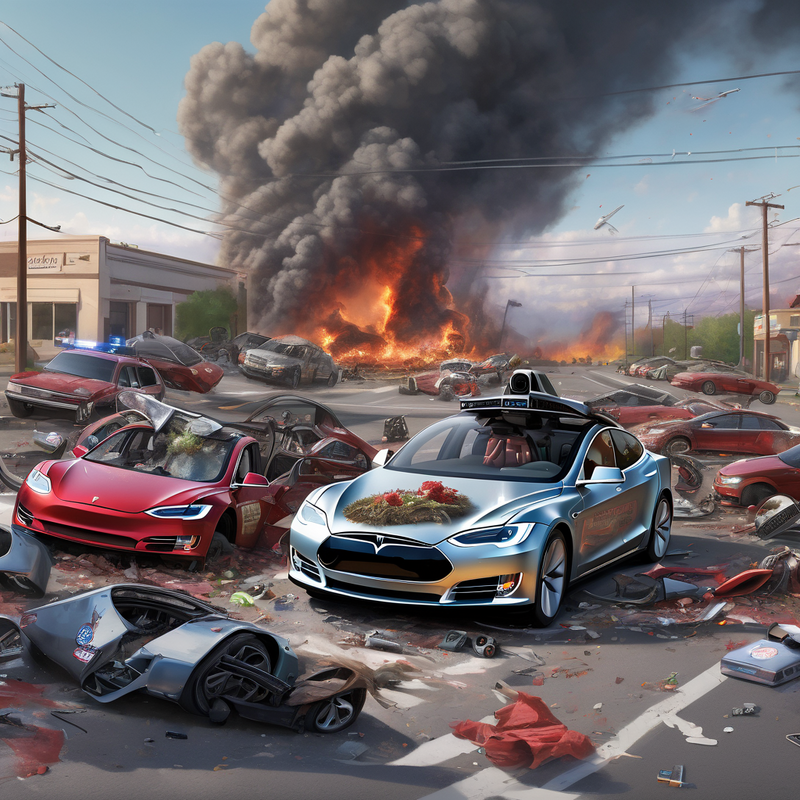
Tragedy on the Road: The Price of Overconfidence in Autonomy 🚗💔
In a quiet South Bay area, where palm trees sway gently in the coastal wind, echoes of laughter transformed into whispers of disbelief and sorrow. An 18-year-old girl, vibrant with potential and dreams, lost her life in a tragic single-vehicle crash involving her Tesla. The irony is striking: a car designed to enhance safety and reduce the human error that often plagues driving instead served as the vessel for unexpected tragedy. Were we too quick to embrace the allure of self-driving technology? 🤔
The Incident: What We Know
The accident occurred on a seemingly ordinary afternoon when her Tesla veered off the road. Investigators are piecing together the sequence of events that led to this heartbreaking moment: was the car in autonomous mode? Were driver attentiveness and external factors at play? Data from the National Highway Traffic Safety Administration reminds us that 94% of serious crashes are due to human error, yet this cautionary statistic rings hollow in light of personal grief. 📉
A Collision of Cultures
This incident isn’t merely a reflection on the capabilities of modern vehicles; it’s a haunting illustration of the clash between youth culture and technological dependence. Today’s teenagers grow up in a world where convenience is paramount, and the notion of a human-driven car, *once deemed essential*, is increasingly met with skepticism, juxtaposed against the efficiency and allure of automation. Self-driving cars are marketed as the pinnacle of safety but can they truly replace human intuition?⚖️
The Allure of Autonomy
Consider for a moment how we’ve ingrained trust in technology. Many perceive driving as a chore, a mere footnote in the quest for leisure and connectivity, while cars of the past associated freedom with youthful exploration and adventure! The youth often view Tesla as a definitive statement about the future, embodying environmental consciousness and innovation. Ironically, this reliance on technology can foster a dangerous overconfidence, as if chariots of steel couldn’t be tainted by the fragility of human life. 🌍
Fractured Safety Assumptions
Automotive safety technology has advanced with remarkable speed, but the perceptions of its reliability leave gaps wider than the proverbial Grand Canyon. The promise of fewer accidents—of bustling society seamlessly transitioning into autonomous driving—paints an enticing picture, yet skepticism looms. In 2021 alone, over 42,000 fatalities occurred on U.S. roads, serving as a grim reminder of the complex reality we inhabit. 😢
Statistics show that Tesla vehicles have been involved in a series of accidents related to their Autopilot feature. Despite company claims of enhanced safety, questions about driver readiness and technology reliance persist. Who bears the responsibility when an autonomous promise fails? ⚠️
The Road Ahead: Questions that Haunt
As investigators delve into the specifics of this tragedy, one questions the broader implications. Will this incident catalyze a reevaluation of autonomous vehicle regulation? Are we, as a society, too seduced by the conveniences of modern technology to acknowledge its potential dangers? The balance of convenience and caution wobbles precariously, like a tightrope walker in search of equilibrium. 🧗♂️
A Personal Anecdote
In my own circle, I have witnessed friends excitedly sharing their ease-of-use experiences with Tesla’s self-driving features. Like a mesmerizing dance, they recount stories of relaxed journeys, equipped with nothing but a smartphone and faith in their vehicle. Yet, amidst the laughter and thrill, I can’t help but recall the warnings echoed by safety advocates. Does the thrill of convenience outweigh the unsettling potential of technology’s grip on our lives? 🤷♀️
Reflections on a Presumed Safety
As we ponder the implications of this heartbreaking event, it demands a profound reflection on our readiness to embrace change without fully understanding the stakes involved. For every promising technological leap, there are shadows lurking in the background, questions about accountability yearning for answers. The death of this young girl serves not just as a statistic but as a stark reminder to ensure that, in our quest for progress, we do not forsake our fundamental instinct for caution 🚦.
Ultimately, this tragedy amplifies a more profound existential query: In an era replete with technological possibilities, how do we maintain our role as vigilant custodians of safety? And what steps can we take to ensure that our future on the road doesn’t come at the reckless expense of our present? It is a narrative woven with sorrow but emboldened by the hope that we can learn, adapt, and above all, drive with our eyes wide open. 🌅



I dont buy the whole hidden dangers narrative. Autonomy has benefits but needs refinement. Lets not throw the baby out with the bathwater.
I disagree with the notion that autonomy is solely to blame for the Tesla crash. Human error and road conditions must also be considered.
I dont buy the whole hidden dangers narrative. Autonomy is the future, accidents happen. Lets focus on improving technology.
I disagree with the notion that autonomy is to blame for the Tesla crash. Human error cant be overlooked.